Build your own social network: choose the first community workflow
Facebook, Instagram, X and Reddit are references for different participation models. A small community app should pick one: photos, short posts, private groups or topic discussion. The strongest starting point is a clear reason for members to return and a small set of working interactions.
By Clone4.me · AI-assisted editorial ·
A practical starting point
Choose your content unit and membership model first, then implement create → publish → read → reply → moderate. Use a real backend for shared content, check authorization on every access path, and start with a controlled community instead of an unrestricted public network.
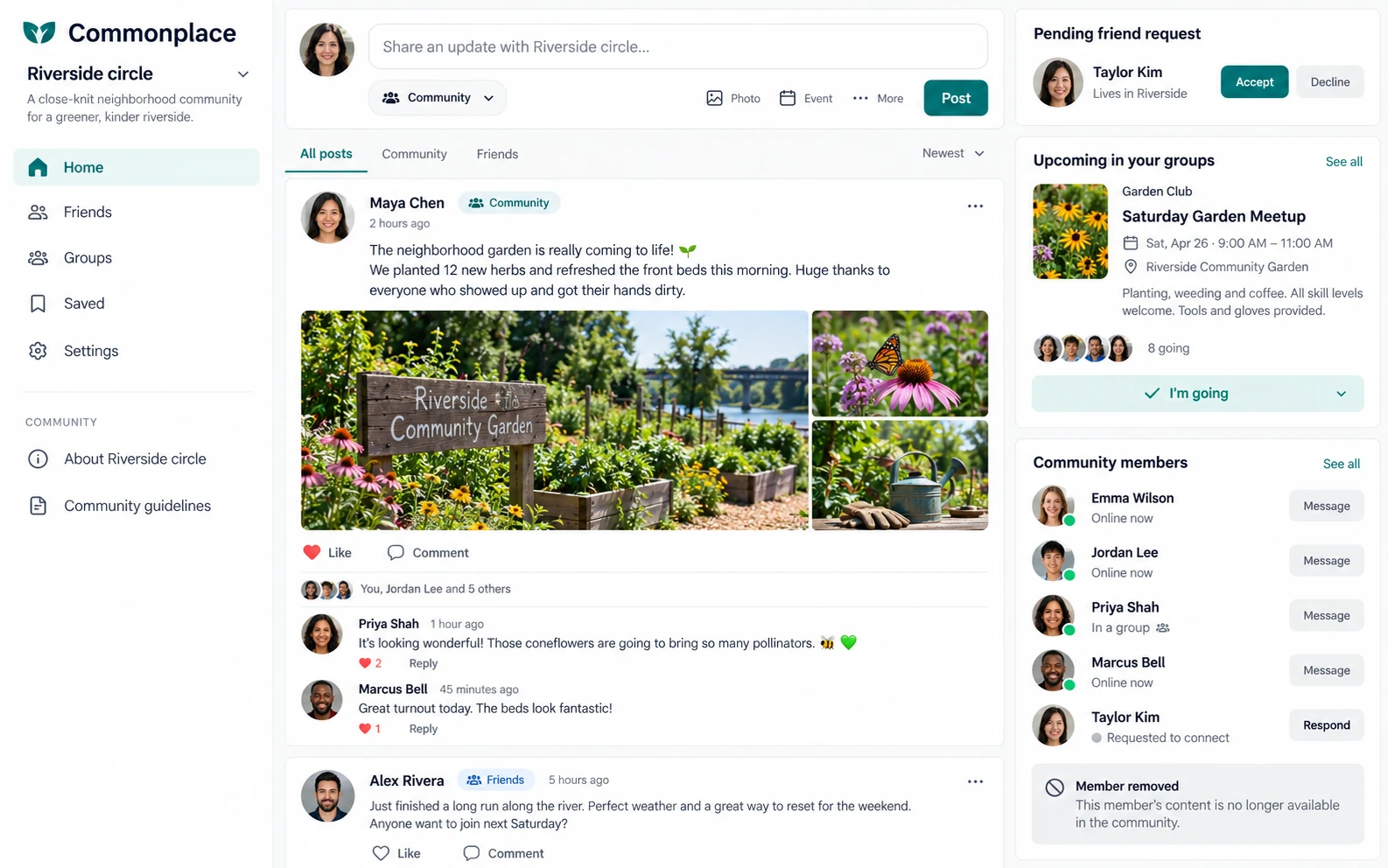
Choose the content and relationship model
Photo sharing needs original uploads, captions and visibility rules. Microblogging needs post/reply relationships and stable timelines. Group discussion needs membership, topic organization and moderator actions. These are not interchangeable skins over the same database.
Select the reference whose core unit matches your community. Add one strong journey, such as posting a photo to a private club or asking and accepting an answer. Avoid making a long reference-product checklist your first scope.
| Reference workflow | Core unit | Important first decision |
|---|---|---|
| Instagram / Pinterest | Photo or saved visual item | Who can view the original media? |
| Twitter / X | Short post and reply | How is timeline order defined? |
| Posts within relationships/groups | What is the membership and visibility model? | |
| Reddit / Hacker News | Topic or link discussion | Who moderates and how are replies ordered? |
| Stack Overflow | Question and answers | Who can accept an answer and revise a post? |
Make permissions work beyond the feed
A private post must remain private through its direct URL, API response, search result, image endpoint and notification. A hidden button is not access control. Check membership and object ownership on the server for reads and writes.
OWASP recommends denying access by default and validating permissions on every request. Apply that principle to your selected model. Test an outsider account against a private group, an archived post and a media attachment, then repeat after membership is revoked.
References: OWASP authorization guidance
Start with explicit feed ordering
Use a chronological, following or topic-based feed with a stable tie-breaker and pagination. Describe that behavior plainly. You do not need to invent AI recommendations to make a small community useful.
Likes and follows should be idempotent operations with real stored state. Replies should not disappear or duplicate when the connection retries. Show empty and unavailable states, and decide how edits or deletions affect quoted or linked content. For video processing, use the dedicated TikTok guide rather than treating a video as a larger profile image.
Build the operator’s workflow too
Include block, report, moderation review and removal in the first shared pilot. A report needs an actual destination and state; a “report sent” toast without storage does not help an operator. Decide what happens to replies and attachments when a post is removed.
Start with invited members and clear community rules. Keep user-generated material, personal profiles and media uploads within a scope you can operate. Public growth, anti-spam systems and round-the-clock moderation cannot be established by generating an admin dashboard.
- Test blocked-user interactions through direct endpoints.
- Revoke membership and verify new access fails.
- Remove a post and check search, media and notifications.
- Retry a like or reply and inspect duplicate handling.
Choose a concrete brief to implement
Use Instagram for a photo community, Twitter/X for short posts, Reddit for topic discussions or Facebook for groups and relationships. LinkedIn and Pinterest address more specific professional or visual organizing journeys.
Customize the audience, membership rules and exclusions in the full prompt. Build with original branding and permitted sample content. Verify with multiple accounts before inviting a real community.
Turn the plan into a complete brief.
Copy a tool’s full prompt, customize its sections, and keep the verification requirements with your project.