Build a custom Wordle generator with AI
A custom Wordle generator lets a creator choose an answer and share a playable puzzle with someone else. That adds a creation-and-sharing workflow to a word game. This is a build guide and prompt extension, rather than a playable generator hosted on Clone4.me.
By Clone4.me · AI-assisted editorial ·
A practical starting point
Start with a pure scoring function and a permitted word list. Add a creator form, validated answers and a puzzle identifier. Decide whether answers can be inspected in a casual client-only game or need server-side storage, then test repeated letters before visual polish.
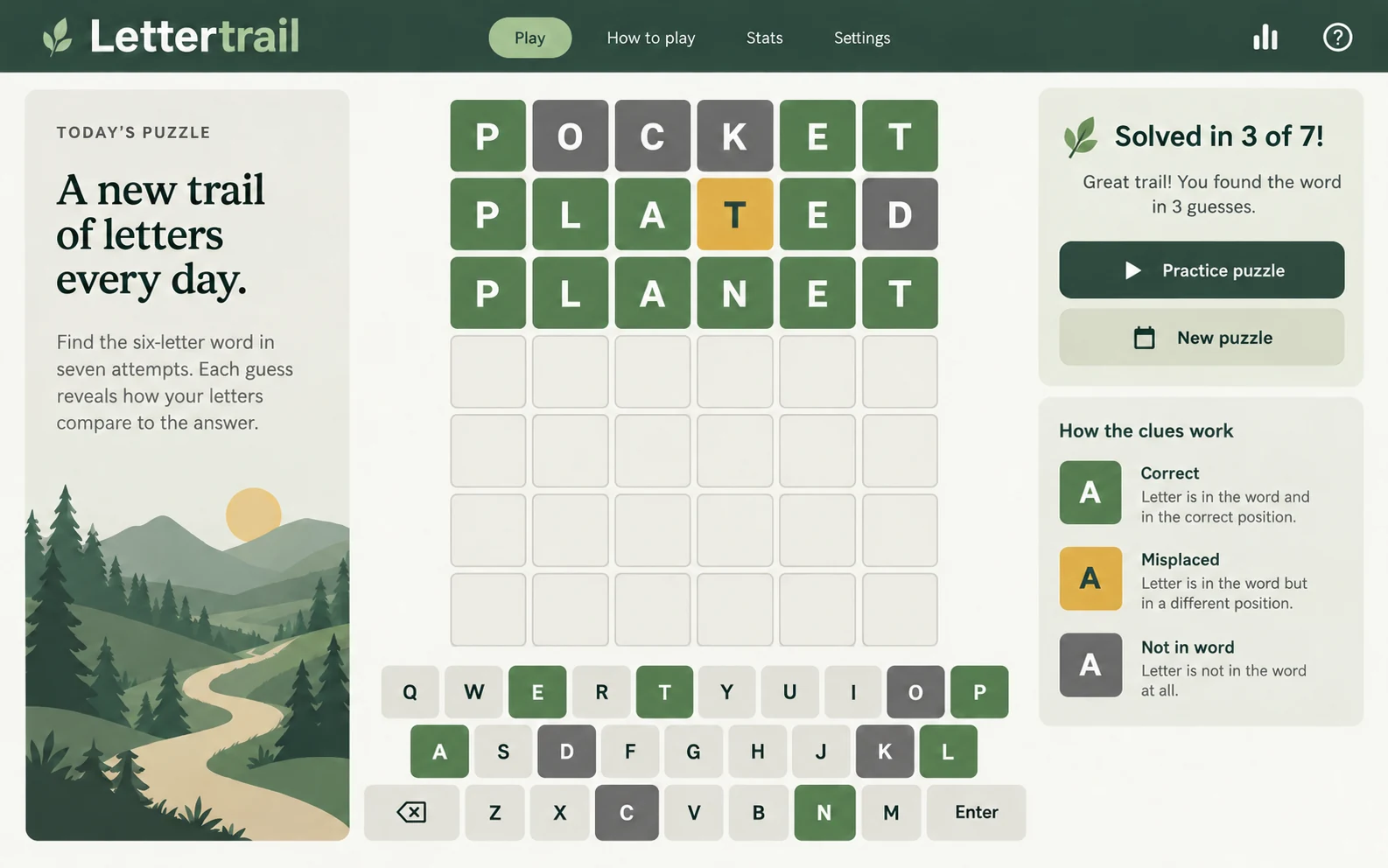
Separate the generator from the game session
The creator chooses an answer, validates it and optionally adds a short original message. The solver opens a puzzle, submits guesses and receives feedback until success or the allowed attempts are exhausted. A generator needs both journeys; a daily puzzle screen alone does not satisfy the requirement.
Keep the allowed-guess list separate from the permitted-answer list. Decide how case, accents, word length and non-letter input are handled. Use an independently selected or appropriately licensed dictionary, original branding and original share text. The baseline Wordle brief covers local play; generating shareable puzzles is a deliberate extension.
Score repeated letters with remaining counts
First mark exact-position matches and reserve those answer occurrences. Then walk the unmatched guesses and mark a letter present only if an unconsumed occurrence remains. Otherwise mark it absent. This avoids awarding two present letters when the answer contains only one remaining occurrence.
For the original test example answer APPLE and guess ALLEY, the states are correct, present, absent, present, absent. Reserve A first, allocate the single L once, then allocate E. Keep this function independent of tile animations so it can be checked without a browser.
| Guess position | Letter | Expected state |
|---|---|---|
| 1 | A | Correct position |
| 2 | L | Present elsewhere |
| 3 | L | Absent: the L occurrence is already allocated |
| 4 | E | Present elsewhere |
| 5 | Y | Absent |
Choose how puzzle links protect the answer
A client-only link can encode the answer or enough information to derive it. That is convenient for casual puzzles, but it does not make the answer secret; encoding is not encryption. Explain that limitation instead of calling the game tamper-proof. Do not put private messages or sensitive information into share URLs.
A server-backed edition can store an answer behind an opaque puzzle ID, validate guesses on the backend and rate-limit attempts. Decide how long a puzzle remains available and what deletion means for old links. This adds operational work, so choose it only if those properties matter to your audience.
Make feedback understandable without color
Use labels, patterns or symbols alongside colors, and expose the guess result to assistive technology. Keep keyboard state consistent when a letter has several different results across guesses. Success, invalid guesses and exhausted attempts should be announced without unexpectedly moving focus.
W3C guidance explains why meaning must not depend only on color and why status changes need accessible presentation. These requirements belong in the brief before the agent chooses a tile palette. Test keyboard entry, deletion, Enter submission and the onscreen keyboard at phone widths.
References: W3C: use of color · W3C: status messages
Extend and verify the full puzzle brief
Ask the agent to add a custom-puzzle creation mode alongside the existing local game. Define whether shared puzzles affect daily statistics; a creator should not be able to inflate a daily streak by repeatedly opening their own puzzle. Give each session a stable puzzle ID and restore validated guesses after reload.
Test invalid answers, repeated letters, a last-attempt win, an expired or malformed link, storage failure and a reload mid-game. For a smaller first game, compare 2048; for a different authored puzzle workflow, compare Connections. Keep the generated game’s identity and puzzle collection original.
Add a custom word-puzzle creator with validated answers and shareable puzzle IDs. Clearly document client-visible answer limitations or use backend guess validation. Score exact matches before remaining letter counts; test APPLE/ALLEY. Keep custom puzzles separate from daily statistics and provide feedback beyond color.
Turn the plan into a complete brief.
Copy a tool’s full prompt, customize its sections, and keep the verification requirements with your project.